Sharing Voices: A Podcasting Project
In collaboration with Adobe, eCampus and the Center for Faculty Development, SJSU faculty share their experiences from the Sharing Voices: A Podcasting Project. Read their reflections and view some recordings of their program presentation from the Adobe Digital Literacy Day.
Faculty Reflections and Presentations
Jose Aguinaga, School of Information
This fall 2021 semester made me aware that time management skills are essential in the creation and development of a podcast. Thankfully, while teaching 6-graduate units as a lecturer with the School of Information, it appears that my time ran away from me and I was not able to launch my podcast as I had intended. Klaus Trilck was very helpful during our summer one-on-one and with our future email communication exchanges. I intend to complete the development of my future podcast during the winter break and launch it for the Spring 2022 semester. The handouts that Trilck provided are a great resource to remind me of the numerous resources that exist that will support the creation and development of the podcast. Essentially, my goal is to make up for my scheduled completion of the podcast project during this winter break.
Laura Guardino, History
The Podcasting Program was a great way to get my feet wet with having students produce a new type of media in my course. I love students to produce products and this is a creative way for students to work on a mini concept in my course and demonstrate their understanding. By having my students create a 1-3 minute podcast I was able to quickly grade their understanding of the mini concept and create a library of primary source analysis for the whole class to access. I look forward to doing more with digital media in my online class.
Steven Lin, Music and Dance
Steven Lin, Music and Dance
Thanks to the CFD for putting this workshop on. As a musician, the idea of podcasting is a very natural extension of my work, since I have lots of experience with microphones, recording, and editing. The technical side was never an issue. On top of that, I have a wide network of professional classical guitarists and musicians that I can rope in to converse with. But I needed one little push to get me to actually realize my podcasting ideas, and this workshop was it. I also didn't understand how to set up an RSS feed, but Spotify has made it so easy that it really took about 5 minutes to sort out on Spotify. Finally, what's really great is how much innovation there has been in the podcasting space. The Call In app is a great example of social podcasting made easy and has completely reduced the friction to content production to the point where the content has the most potential to shine through. I remember the days of large recording studios, microphones that cost several thousands of dollars, all kinds of stands and cables and boxes and mixers, plus the professionals required to run them. Just about all of that is gone now, and I'm grateful for it.
Faculty Presentation "My Network is My Content"
A professional guitarist's take on bringing concert artists and international competitions into the classroom.
Complete this form to access Steven Lin's presentation recording.
Cristina Siegel, Environmental Studies
Cristina Siegel, Environmental Studies
Implementing a podcast project into my ENVS10 classes was both rewarding and challenging, with positive end results for both students and me as the instructor. I had many initial concerns about providing an enriching experience that engaged students in the course material, while still providing all the normal class content as well as teaching about podcast creation, which was so new to me. However, I believe providing a solid structure to the assignment and making it a semester long project provided the time and flexibility we all needed. My students were struggling just being back on campus and with the past year+ of covid change and I wondered if this project was too much. It turned out to be semester highlight. They created really solid, if not perfect podcasts, with some creative flair that was fantastic. They were most challenged by the editing process and software and struggled with group project dynamics, yet they all got through it. Their final presentation day blew me away; they conducted good interviews and created interesting, well-done podcasts with visuals. We hope to use parts of these interviews on our department website. Overall, I believe the process and rubrics developed worked well. For future podcast projects, I would want to rethink and adapt how to share/teach adobe audition. Also, interviewing our department faculty is not feasible on an ongoing basis, so I would need to consider different interview or presentation options. Overall, I am truly grateful to have participated in this program and feel it was a success. Students engaged, environmental issues explored, and 11 terrific podcasts made!
Kathleen Normington, Film and Theater
Kathleen Normington, Film and Theatre
This has been a challenge but I learned so much and want to do it again with another group of students. I chose to have the students create podcasts which involved a lot of preparation on my part. Only after their 15 -20 minute podcasts were created did I realize what needs to be adjusted next time. The students seemed to appreciate the opportunity to learn podcasting techniques and were especially excited to interview the guest playwrights. There are definitely aspects of the assignment that I will adjust but it was an incredible learning experience for me and my students!
Faculty Presentation "Building Community and Skills with Podcasting"
A look at how one class used podcasting to strengthen writing, research, planning, interview, and collaboration skills.
Complete this form to access Kathleen Normington's presentation recording.
Esperanza Huerta Espinosa, Accounting and Finance
Esperanza Huerta Espinosa, Accounting and Finance
This was my first experience creating a podcast and teaching about podcasting. I, as my students, started from zero, learning new vocabulary and a new technology. In the future—probably during the summer—I’m planning to create a repository for my students in which they can learn the basics of podcasting. It will probably be a stand-alone mini course that students can complete asynchronously, similar to those in LinkedIn. The mini course will not focus on the technology, as there are plenty of videos on how to use Adobe Audition, but more on vocabulary and podcast elements and structure. In this way, I will be able to reuse the mini-course in any class that I want to incorporate podcasting."
Faculty Presentation "Sympathetic Ears: Students Podcasting"
This presentation describes how students created podcasts to give advice to other students.
Complete form to access Esperanza Huerta Espinosa's presentation recording.
Student Assignment - Part 1 [pdf]
Podcast Assignment Workflow [pdf]
Listen to the podcast, "Programming for Beginners"
Transcript to the podcast, "Programming for Beginners":
Welcome back to talks with CHC, where we may end
up talking until the sun sets.
Hi, everyone, it's CHC. Today we'll be talking
about what you should do to be successful in a
programming course for beginners. When I first
started programming, I struggled a lot.
And because of that, I can tell you it's not
something that came easy to me. Now that I'm a more
seasoned programmer, let me tell you about what
you should do to succeed. To start, read the
textbook. Yeah, I know it might not be fun, but
you have to read that textbook more than once.
Read it two times once before your class and once
more after. Before you go to class, not only should
you read the textbook, but you need to take notes
on the important concepts that stick out to you,
whether that be an actual concept, a function or
command or a definition of a term. It helps to
actually type or write things out because it tends
to stick with you more than if you were to just
read the textbook. After you write those notes,
take it to class and add what is being taught in
class to your notes. After class, review your notes
and open the textbook to read again. When you do this, things start
to come together now that you've heard and seen
everything at least three times. Once you start
getting more interactive with the content, you
begin to learn more. In addition to reading a
textbook and taking notes, find practice problems. If
your textbook doesn't offer anything, go on to
Reddit.com and find practice problems on a subreddit
called r/programming help. There are no spaces.
Here they don't offer you complete practice
problems, but there are people who post about
needing help with their code. You can get practice
by attempting to solve their code, by doing it
yourself and then checking if you've done it right,
by reading the solutions that are offered in the
comments. Similarly, you can go on to stack overflow
and do the same thing. Just browse
through the post and click on a problem that
interests you and relate to the programming that
you are learning. Practice is everything. Using
these websites will give you the opportunity to
read and practice solving other people's codes, as
well as learn from their mistakes and avoid doing
what they did yourself. Finally, the last advice
that I have to give you is to use YouTube. It's an
amazing source for students. You get people all
around the world teaching you how to program. If
one person's teaching style doesn't match yours,
then you can easily find another. On YouTube, you
can pause and replay things at any time. This can
give you a chance to catch up on your notetaking
and have some time to completely understand the
concepts being taught. Just search up the concepts
you're having trouble with and then browse through
the videos to find the one that will help you the
most. The video that will work for each person is
different because everyone has different problems
and a different way of understanding things.
Because of that, I won't go into too much detail
about who to watch and what to watch. And it looks
like time is up so and my advice giving here.
Don't be discouraged if you don't succeed in
coding right off the bat, programming is difficult.
You might run into a lot of problems as you go
through your programming course. But keep in mind
that there are a lot of ways you can mitigate
those hardships. Remember, read your textbook and
take notes. Use online resources like Reddit,
StackOverflow and YouTube and most importantly,
practice, practice, practice. Following these
tests will help you succeed in your programming
course, just as it did for me. I wish you the best
of luck and I'll see you next time. Bye.
Disclaimer, all of the sound effects and
background music are not mine. All sound effects
are from freesound.org and the background music is
from pixabay.com, who's part of these websites for
the Rights and Licencing. Thank you.
Listen to the podcast, "Things to Know at the Start of the Semester"
Transcript to the podcast, "Things to Know at the Start of the Semester":
Welcome to my podcast in which I'm going to talk
about what I wish I had known at the beginning of
this semester.
The beginning of a semester can be an uneasy time
There are students trying to crash and add courses
in order to fill out their schedule and graduate
on time. Students trying to figure out if the classes they are in,
are the right fit for them and much more
anxiety than necessary for college age kids. I
remember the beginning of this semester. It was no
different for me. I was not worried about having to
crash or add any courses, but I was nervous that
certain courses I enrolled in would prove to be
too difficult for me. With this being my last
semester, that possibility frightened me to my
core because it would mean I didn't graduate on
time. One of the courses I was especially nervous
about was Business-one-120G. I had ended up enrolling
in this course because I needed another accounting
elective. Due to the pandemic, the options are
limited. Because of the limited options, I seemingly
chose at random and decided on Bus-one-120G. I was
not even sure what the class was at the time. All
I was concerned with was that it would satisfy the
elective requirement I needed. The first day of
class, I finally learned with the class I had
enrolled in really was programming and systems
development and AIS. I quickly learned that this was
essentially an introductory course to programming which I
knew nothing about and never thought I would
know anything about. I found myself filled with
nerves that the course would be too difficult for
me since it was such a foreign concept. Having now
almost completed the semester, there are a few
things I wish I could have told to my past self in
order to help prepare me for what's to come. First
off, I would have tried to explain what the class was as
opposed to going into it, not knowing anything.
I would have also tried to express how important it is
to, "eat your vegetables". Lastly, I would
have liked to tell myself about the effectiveness
of the trial and error method when writing a
program.
It is usually not a good idea to get involved with
something before knowing exactly what it is you're
getting involved with. The same rule applies to
choosing what courses to take. At the time of
choosing courses, I was blinded by the light at
graduation and did not bother to learn what the
courses were, which I was choosing. Because of
this, the first couple of class meetings were very
intimidating. I wish I could have told myself that,
yes, the courses will teach you how to write
programs, but it will do so at a manageable pace.
What I would have also said was that this course is
specifically for business students, and it is
likely that not many others in the class have
prior programming knowledge either. I remember
thinking what a great mistake I had made picking
this course and how I felt I did not belong in the
class. I believe that knowing what the course was
going to be, knowing I was not the only one
without prior knowledge and understanding that the
course was designed for students like me would have
not only helped me prepare for this course, but would have
also helped ease my nerves in those first few
weeks. Another piece of advice I would have liked
to tell myself at the beginning of the semester is
the importance of eating your vegetables.
Professor Huerta does not make practice
programs mandatory. Instead, she encourages students to
complete them for their own sake as opposed to for
the sake of grade. Huerta uses the analogy of
eating your vegetables to explain this importance.
People don't usually like to eat their vegetables,
but is very important to do so to ensure that
you're getting the nutrients needed. Doing the
practice problems is very similar to that.
Students don't often want to do extra work if it
is not required for grade, but doing so here is
very important to fully understand the material
and pass the course. I believe that had I actually
understood this lesson, I would have completed
more and more of the practice problems and would
have had a much better understanding in the course
and a better grade than I do now. The last thing
that I wish I could have told myself at the
beginning of the semester is how effective the
trial and error method is to writing and solving
programs. During the first few weeks of programming,
I felt like a fish on a bicycle, completely unsure
about so many aspects of what I was trying to do.
One of the things I discovered later in the
semester that helped me a lot with writing
programs was how helpful trial and error was in
getting a program to do what I wanted to do. This
involves making small changes to programs and then
attempting to run them and doing so over and over
again until the desired output was given. Once I
learned the trial and error method, I began to
succeed at a much higher rate in writing programs
and I would advise any new programmers to use this
method.
Had I known all of these things at the beginning
of the semester, I believe that I would have been
a much more successful student in this class than I
actually have been.
Thank you for listening to my podcast. Don't
forget to like and subscribe down below.
Good bye.
Steven Silver, Marketing and Business Analytics
Steven Silver, Marketing and Business Analytics
Before the program, I had only passing experience with podcasts. I now will be working with them in the course. A continuing challenge in a required statistics course for students who have limited interest in statistics is to communicate assignments and why it is to their benefit to complete the assignments. The viewing of posted content is limited. I can assess this since the instruction in the posting are often not followed in the assignment.
Podcasts provide an opportunity to further engage students in addition to the outgoing podcasts, I will be requiring students to turn in sections of the assignments in podcasts. So, there will be a continuing exchange of podcasts. The program encouraged the use of podcasts and reviewed the methodologies to construct them. My goal for subsequent podcasts is to build more variation in media and content used in podcast so as to increase engagement by students.
Ruth Rosenblum, Nursing
Ruth Rosenblum, Nursing
I really enjoyed this project. I learned so much about podcast editing, etc, though each time I produced one it was like starting over.....
I was 'blown away' by my students' podcasts. Some were just OK - talking for 10-12 minutes about a topic, but some were exceptional! The interviews! The music! The production! It was truly amazing. Students claimed it took a lot of time (I agree) and that a typical discussion board entry would have been faster, BUT they really enjoyed producing and listening to their peers 'casts. One student stated that she enjoyed it so much that she is going to start her own podcast!
It was a really fun and interesting way to produce scholarly activity, though time consuming -- probably equal to writing and editing a scholarly article.
Faulty Presentation "Podcast Nuts and Bolts: How the RN Right Now! Podcast was Developed"
This presentation describes the podcast series and assignment requirements for a graduate class, based on the Adobe Digital Literacy podcast project.
Complete form to access Ruth Rosenblum's presentation recording.
Jennifer Wolf, School of Social Work
Jennifer Wolf, School of Social Work
Emily Wughalter, Kinesiology
Emily Wughalter, Kinesiology
For every program I have participated in through eCampus for 6 or more years I learn new technologies that assist me in teaching students at SJSU. Specifically through the Sharing Voices program, I learned Adobe Audition and how to use it at a fairly novice level though I can cut and paste for editing, and I know how to upload to Sound Cloud for listening. I use Camtasia often and sometimes tried to associate the ideas contained in video and audio only production as similar. I really enjoyed listening to the videos of the faculty participants. I am amazed at the creativity and ideas that our faculty implement in their teaching methodologies. I am glad I took the time to learn these new tools and also to be able to incorporate them into my classes both as a listening device and as an assignment device.
Business Professor Esperanza Huerta Espinosa created this graphic to demonstrate the workflow for students to create a podcast in her class.
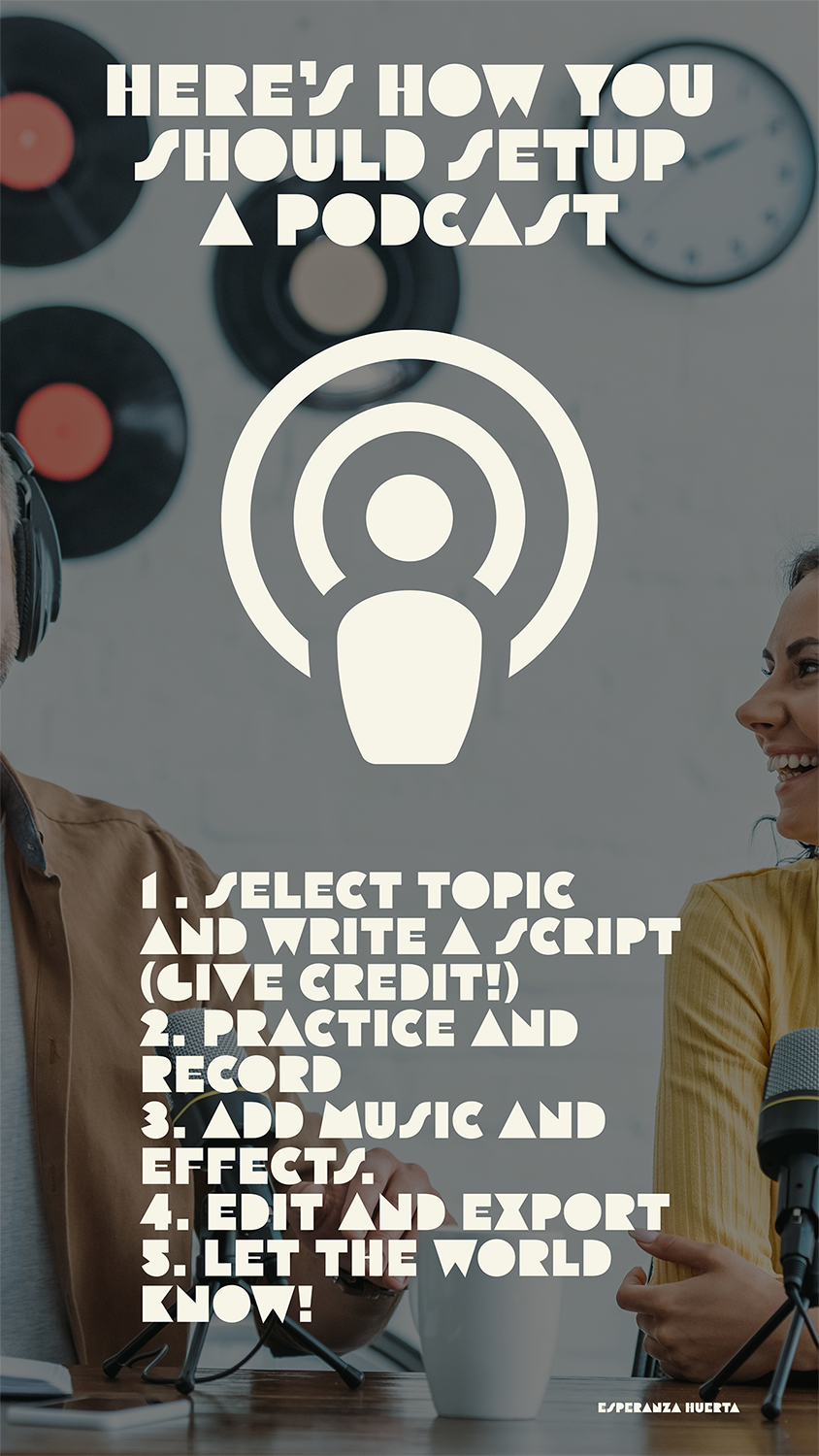
Here's How You Should Set Up a Podcast:
- Select topic and write a script (give credit).
- Practice and record.
- Add music and effects.
- Edit and export.
- Let the world know!
